The peat depth map shown on the CEP website is the fourth one using the same data collected in 2022 by a firm called TNEI. Two young employees probed the peat at 100 metre intervals. “A lad and a lass were sliding about north of Gablestone. Peat’s deep there.”. This data now belongs to CWF Ltd.
The first map made from this data in 2022 is shown below.

The colour scheme of the map makes it hard to follow, and the algorithm used to fill in between the probed points is primitive and deceptive, but this map does tell us some things that the later maps do not. The peat is non-existent on the Pack Horse ridge and on the lowest slopes of Hoar Nib; no CEP turbines are proposed for either area. The bump on the right is no longer inside the wind farm boundary. The probing was done to at least 6 metre on the yellow. .
The algorithm used to fill in between the probe positions was “Inverse square weighting”. This is a primitive method that takes an average of the twelve nearest probed depths with further away depths having much less weight in the averaging. Double the distance; a quarter of the weight.
The physical act of probing is exhausting once the depth is more than a metre. At three metres you need a weightlifter’s squat lift to get the probe back out again. Greater depths are very time consuming indeed. When we look at the next two maps we will see a blank area that is not present on this first map. The blank area is highly significant and the depths shown on this TNEI map in the blank area are fictional. The algorithm has used depths from far away to fill in a big gap in the data. For some reason the young employees were not allowed to finish the job. Nothing sinister: just incompetence by the management.
The second map made using the same data was published in the September 2023 Scoping Report for the original 65-turbine Calderdale Wind Farm (CWF)

This map looks very different but uses exactly the same data as the purple map. Natural Power are a highly respected firm of consultants. The map shows the probing positions, including the ones taken in the hump on the right which is no longer inside the boundary. The Kringing algorithm has been used to fill in between the probing cross depths. This method is expensive in computing time and makes optimal use of the data. Because Natural Power are a respected firm, they have not hidden the fact that the algorithm is unable to produce interpolated depths where the peat survey had not been completed. The blank area by T14 is caused by the failure to complete the survey. The Kriging algorithm has a setting that tells it when to give up: and Natural Power had it turned on. If the data isn’t good enough, a blank is printed.
We cannot use the purple map to fill in the blank section, because the depths in the purple map over the blank area are completely fictional and based on very distant probing. This is what makes the purple map so deceptive.
The author has probed the peat on Walshaw Moor in many places using a 3 metre avalanche pole, tending to probe where the tracks are going. In some places the depth found has not agreed with the interpolated depth by a full colour difference, but the picture shown in the map seems broadly correct. Below is near Dean Stones with Professor Mike Fox and Dr Mariacarmen Tapia of University of Santiago di Compostela with just over a metre of depth. Note how long the probe is.

NICK MACKINNON
In the photo the 3 metre probe is buried to the hilt where the Brontë skyline meets the Walshaw Moor Plateau. The peat here is completely intact with no groughs or hags. Chris Goddard ran in snow along here to get to White Swamp.

NICK MACKINNON

CHRIS GODDARD
CWF Ltd made a cardinal error now. The depth of “deep peat” in England is 0.4 metres or more (and may soon be 0.3 metres following a Defra consultation). In Scotland the definition is 0.5 metres or more, and the consultants, based in Castle Douglas in Galloway, used 0.5 metres as the cut-off between dark green (< 0.5 m) and light green (0.5 m – 1 m). The blank area (which could have been surveyed in a morning for less than £1000) and the 0.5 m depth area were to cause the huge embarrassments for CWF Ltd on the Launch Day of Calderdale Energy Park.
The damage done to peat by building a wind farm on Walshaw Moor happens in two ways. One is in the direct digging of foundation holes and road trenches. The excavated peat is done for because its structure is lost. The more extensive damage happens over time. All the wind farm infrastructure has drainage ditches, and these drains dry out the peat in a wide margin around the infrastructure. A 50 metre margin is assumed even by CWF Ltd in their maps of access tracks over off-site peat (Option A over Oxenhope Moor and Option B over Sandy Hill Moor). The margin can be much larger; it depends on the slope.
The point to understand is that the main damage to peat is done by drainage over decades and the tracks are where most of the damage happens. The turbine layouts we have been shown for CEP (which are utterly faulty in aerodynamics) do not show the worst peat damage that will occur, which is either side of the tracks.
If the peat is less than one metre deep, a six-metre wide trench is cut down to the ‘competent ground’ which on Walshaw Moor is usually yellowish boulder clay spread like butter on the flat sandstone by the last glacier. This trench is filled with “bulk fill” quarried in West Yorkshire, but the top 40 cm has to be a hard roadstone and this will have to be imported to the site. Limestone is not suitable because it is a blanket bog poison. Granite is used at Ovenden Moor WF. It looks like the ballast used in railway construction.
If the depth is more than one metre the amount of materials to fill the trench, and the amount of spoil peat to be disposed of, becomes uneconomic. Now a floating road is built directly on the peat surface. These have to be as light as possible, so only the hard roadstone is used.
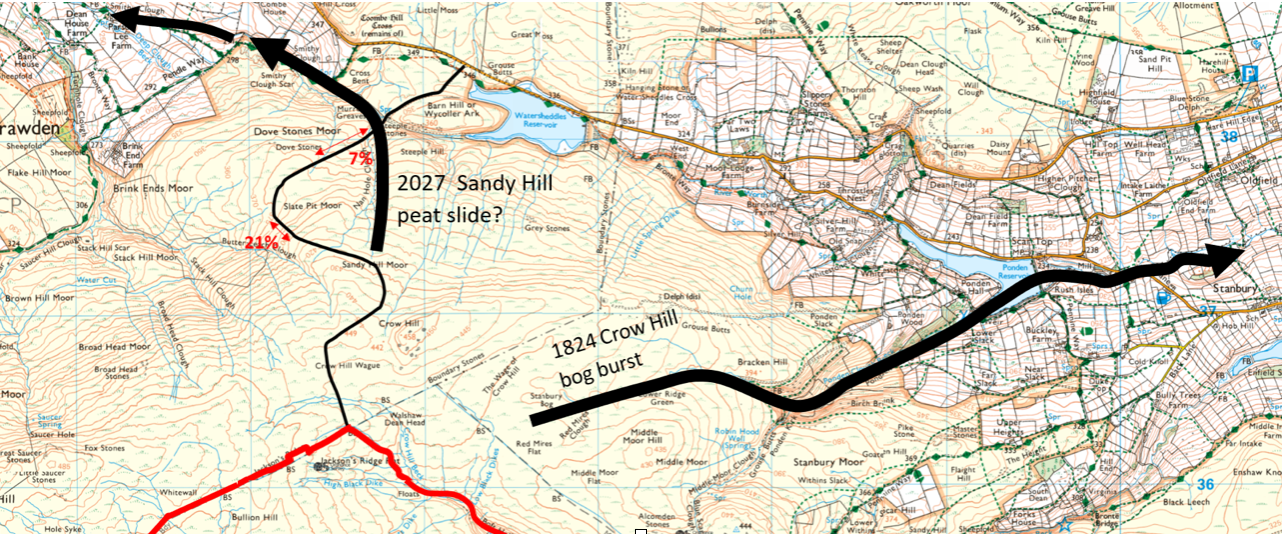
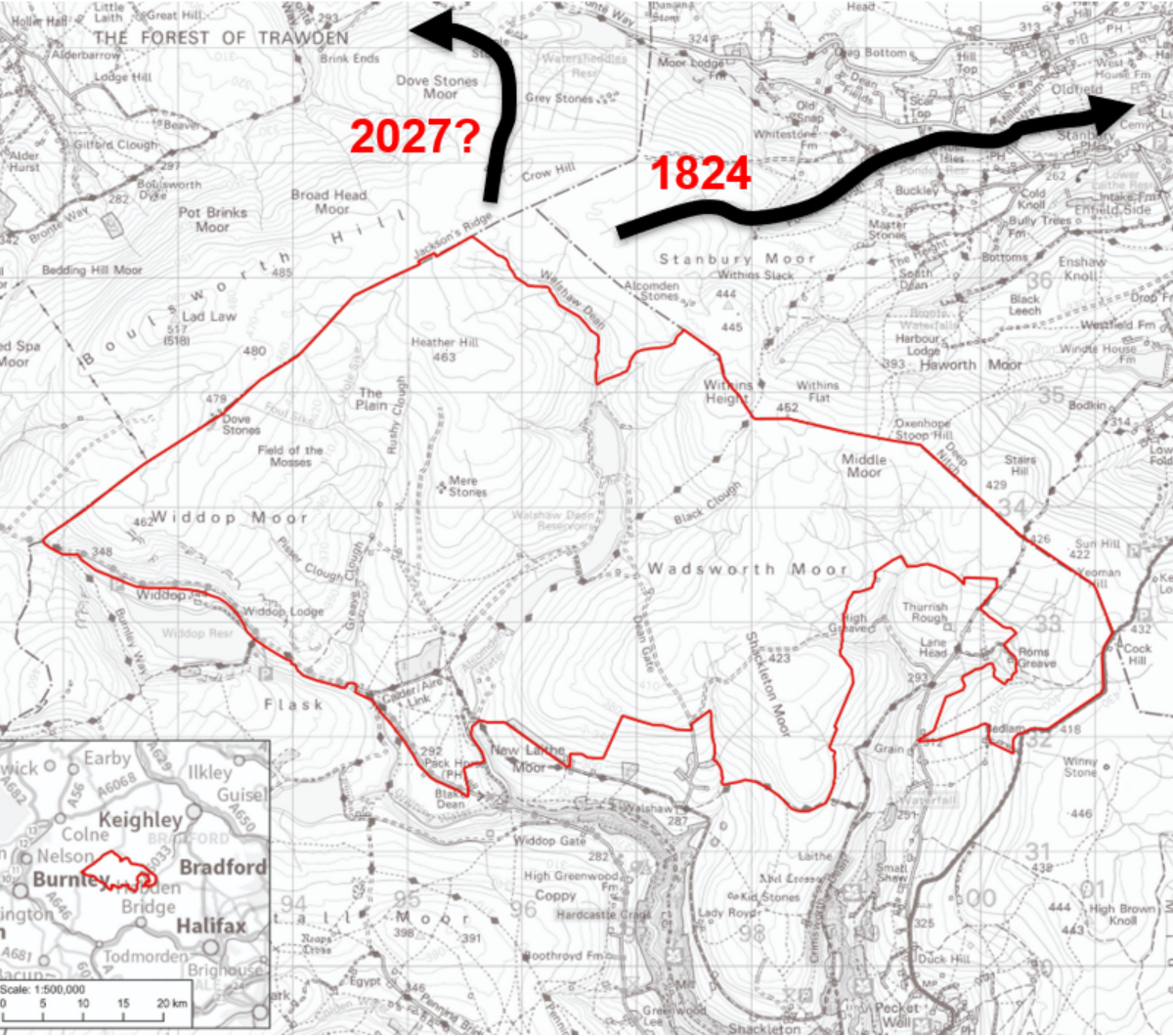
Neither the cut nor floating track should be at an angle to the contours. The track either goes straight up the slope or runs along watersheds. Other angles risk peat slides, and the risk is exceptional at the north of the site, where a vast bog burst exploded in 1824. Normal wind farms have a maximum gradient on the spine tracks of 10% with 12% on spurs. The CEP layout is incompetent and requires a 21% gradient to get up Option B access and a 26% gradient to get down to T22.
It is not possible to build an economic wind farm on Walshaw Moor using only the watersheds. The system track structure is a spine track running along watersheds, with spurs dropping down to the edges, trying to cram as many turbines as possible onto the peat. The spurs tracks inevitably drain the watershed peat, and act as storm drains in heavy rain, raising the flood risk. The effect is most evident on Heather Hill, which is grossly overcrowded.
Returning to the blank area, the diagram below shows how poor the 2022 survey was here.

Inside the red boundary we have very little idea of what the peat depth is. The Kriging algorithm is guessing the depths from very few crosses and eventually gives up.
Now we look at the third peat depth map, published by CWF Ltd on 29 April 2025.

Although Natural Power has their logo on this map, they were unaware of it when I rang them in May 2025 to ask about the various glaring errors. There is a T42 just south of the middle reservoir dam and no T38, which would be expected between T37 and T39, exactly on the blank area. The scale is wrong. Dark green is now < 0.4 metres and light green is 0.5 – 1 metre, but this leaves a gap between 0.4 metres and 0.5 metres. The incompetence which caused these remarkable errors will be described later. The author told CWF Ltd about their incompetence at 09.06, 1 May 2025, and corrections were published at 10:30 the same day (T38/T42) and a couple of days later (0.4-0.5).
This map is less honest than the Scoping Report map because it does not show the probing crosses. Without the earlier map, we would not know what had caused the blank section or how extensive the problem was. The same data has been used, but this time the cut-off on the dark green area is 0.4 metres, the correct definition of deep peat in England.
The current version of this map on the CEP website is shown below. The T38/T42 error has been corrected and so, clumsily, has the key.

“Please note: a typographical error has been identified in the key on the Peat Depths Map published as part of the non-statutory consultation documents. The interpolated peat depth (m) band 0.5 – 1 should be labelled 0.4 – 1. There are no changes to details on the map itself and the map represents a worst case scenario based on the surveys undertaken to date. Further peat work is ongoing. “
There are several things wrong about this correction. The error was not “typographical”. It was a systemic consequence of the original failure to use the English definition of “deep peat”. Further peat work was not “ongoing” because it was the ground -nesting bird season and peat surveying would have been a criminal act. The map does not represent a “worst case scenario”. It represents the peat depths found by two youngsters in 2022 on a 100 metre grid, interpolated using an industry-leading algorithm that refused to cover up the probing failure.
The correction was too late for the printed Consultation Brochures, and stickers had to be inserted by hand. “Like schoolboys doing their Italia 90 Panini albums” said one observer.”
To get maximum information out of the four peat depth maps we need to use them together. It is important not to overstate the deficiencies in the Peat Depth maps. All of them are infinitely superior to the Defra “AI-enabled” peat map of England which is irrelevant to any detailed discussion of Walshaw Moor.
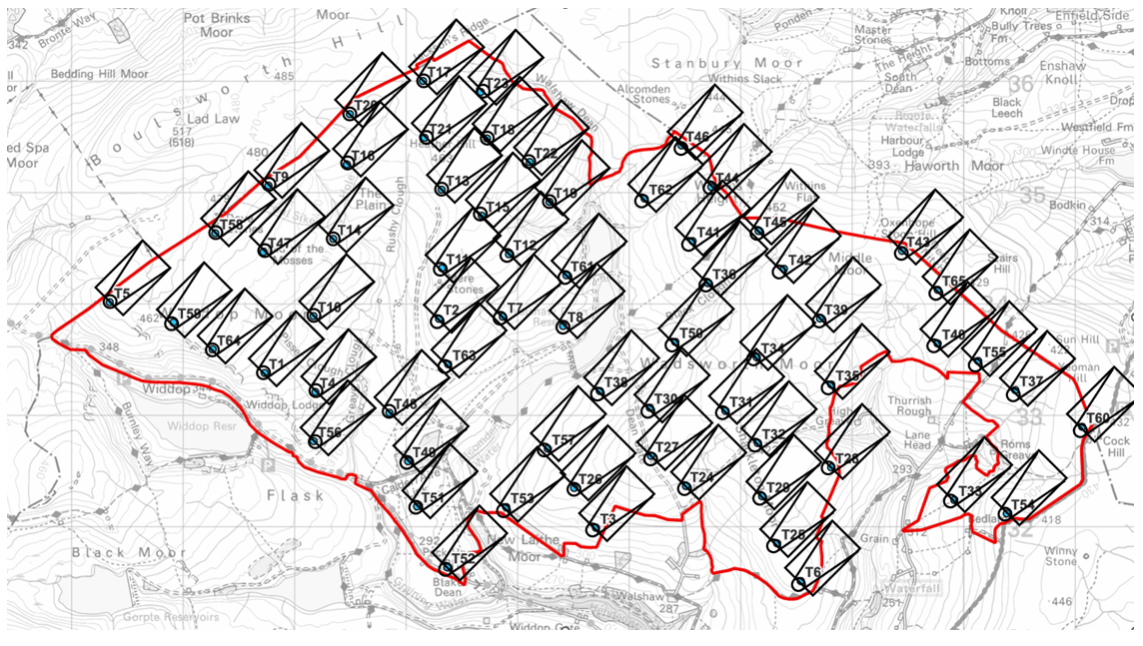
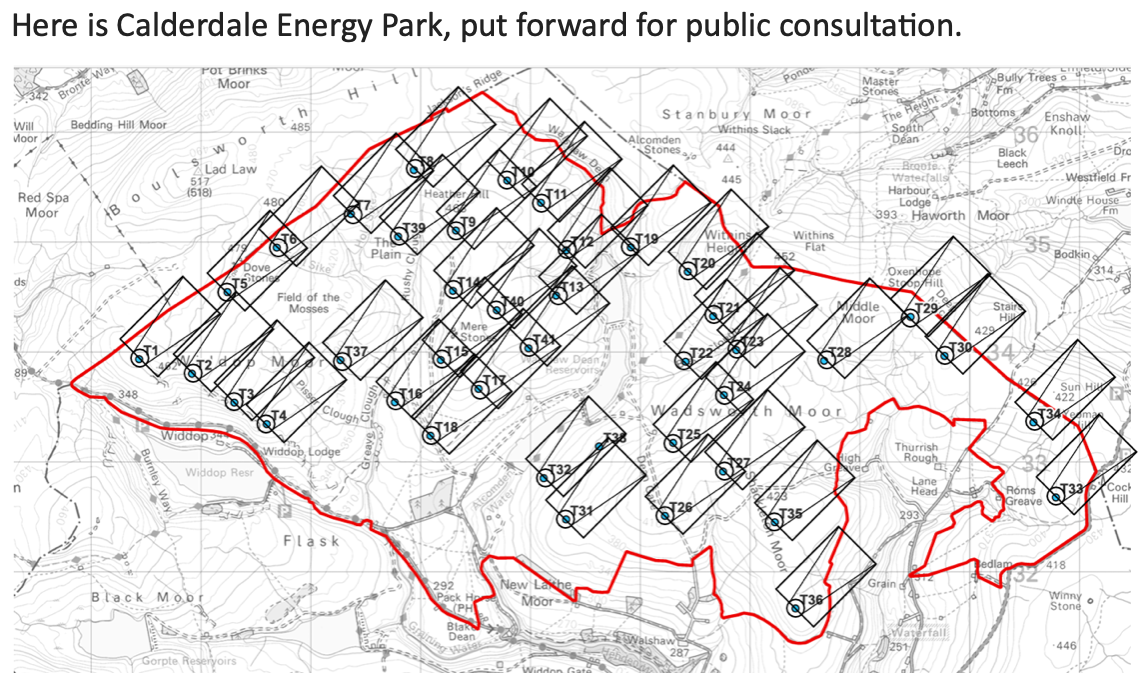
The 3M/T42 problem was caused by the blank on the peat map. The layout of a 42-turbine CEP had been completed at the design meeting on Friday 21 February 2025 when it was noticed that 3M was on the blank area of the peat survey.

T38 was deleted from the design meeting layout map and row 38 was deleted from the Excel spreadsheet of six-figure turbine locations. T42 now sat in row 41 of the spreadsheet. The layout spreadsheet was saved as 210225-41t and this spreadsheet was sent to the cartographers JWO and LF (not known to Natural Power) who faithfully prepared seven maps of the faulty layout on 14 March 2025. These faulty maps were loaded to the CEP website. In early April the T38/T42 error was noticed and fresh maps were prepared on 14 April 2025, but these were not loaded to the website and nobody checked.
At 0906 on 1 May 2025 Nick MacKinnon told Tom Andres of Cavendish Consulting that they had a problem and he had better ring Project Director Christian Egal and Executive Chairman Christopher ‘440 Kelvin Volts’ Wilson to find out what to do.
At 1030 the right maps were loaded and this correction popup still appears on the website.

The statement “The location of T38 has not been changed” is untrue, does not stand up to the internal evidence and has been explicitly denied by CWF Ltd consultant Donald Mackay, who said, “T38 was on the blank section of the peat map, so we moved it.” CWF Ltd has zero employees. Everybody is a self-employed consultant. The loyalty of all the CWF Ltd consultants has to be to their own businesses first. Donald Mackay goes further. A native of one of the most morally upright societies on Earth, Donald Mackay does not tell lies for Christopher Wilson.
CWF Ltd say these errors are typos, but if they are not important indications of their own misgivings about their proposal, why did they print this childlike lie about T38? As ever, the cover up is always worse than the original mistake.
© Nick MacKinnon WTRG